
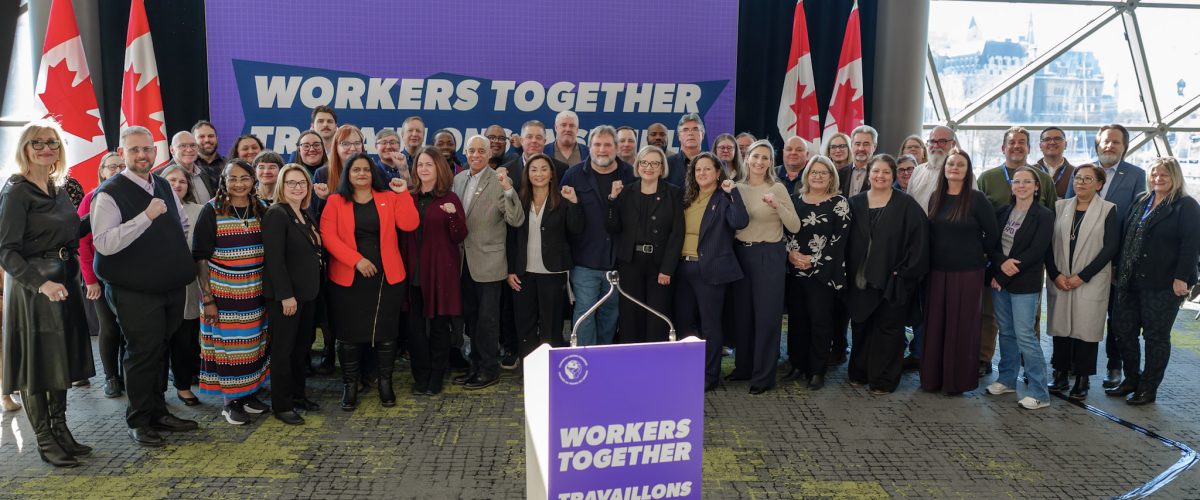
As global trade tensions intensify and economic uncertainty grows, Canada’s labour movement is urging the federal government to change course on trade policy and put workers at the heart of economic decision-making.
Labour leaders from both the private and public sectors gathered in Ottawa this week to discuss the future of Canada’s trade strategy, warning that decades of closed-door decisions have left workers, families, and communities paying the price. Job losses, weakened domestic industries, and underfunded public services, they said, are the result of policies that prioritized corporate interests over people.
The discussion brought together IAM Union leaders alongside leaders from the Canadian Labour Congress, Unifor, the Canadian Union of Public Employees, the United Steelworkers, and the Public Service Alliance of Canada. Despite representing different sectors, speakers shared a common message: Canada needs a worker-centred economic strategy that protects good jobs, strengthens domestic industry, and upholds human rights.
David Chartrand, Canadian General Vice-President of the IAM Union, told the audience that Canada is being pushed into a false choice between trade instability and exploitation.
“We’re being told there’s only two options: either we accept Trump-style trade chaos and tariff wars or chase cheap production by deepening ties with countries that rely on forced labour and state-subsidized overcapacity.”
He emphasized that sectors such as aerospace, manufacturing, energy, and public services are not just economic drivers but strategic national assets that must be protected.
“You don’t build a strong economy by cutting workers out of it,” Chartrand said.
Canadian Labour Congress President Bea Bruske echoed those concerns, pointing to the long-term consequences of past trade policies. She noted that promises of prosperity made in the 1990s never materialized for workers, instead leading to plant closures, precarious employment, and hollowed-out communities.
Bruske warned that signing new trade agreements without clear domestic plans or enforceable job guarantees risks repeating the same mistakes. She stressed that Canada must be prepared to walk away from bad trade deals and ensure workers and unions are involved from the beginning.
Throughout the discussion, labour leaders called for greater transparency in trade negotiations, enforceable labour standards, and public investments that come with real job guarantees. They argued that trade should be used as a tool to build Canadian industry and strong public services; not as an end in itself.
The message from the labour movement was consistent and unified: Canada’s economic future must be built with workers at the table, not after decisions have already been made.